AI customer service on LINE: AI answers first, people take over
LINE is how most customers in Taiwan reach a business, and repeat questions quickly bury support teams. How to design hybrid support where AI answers, checks your systems and knows when to hand off.
Key takeaways
- Most customer service messages are repeat questions (order status, shipping fees, returns, opening hours), and those are the best fit for AI.
- AI has to be able to check your systems (orders, shipping) to answer the questions customers actually ask most, like “Where's my package?”
- Complaints, upset customers and anything involving money should go to a person right away, along with the conversation so far.
- After launch, track three things: the AI resolution rate, the reasons for handoffs, and how satisfied customers are with the replies.
Table of contents
For brands, online stores and service businesses in Taiwan, LINE (the messaging app most people in Taiwan use every day) is often the single most important customer service channel. Customers are used to asking questions there, and they expect a reply about as fast as a friend would text back: ideally within a few minutes.
But once hundreds of messages a day are coming in, a support team gets buried fast. Look closely at those messages and you'll notice that most of them are the same questions over and over:
- "Has my order shipped yet?"
- "How much is shipping? How much do I need to spend for free shipping?"
- "Can I return this? How?"
- "Is this item in stock?"
- "What time does the store open?"
None of these are hard, but they take time, and they tend to pour in after hours and on weekends.
Hybrid customer service: AI on the front line, people for the judgment calls
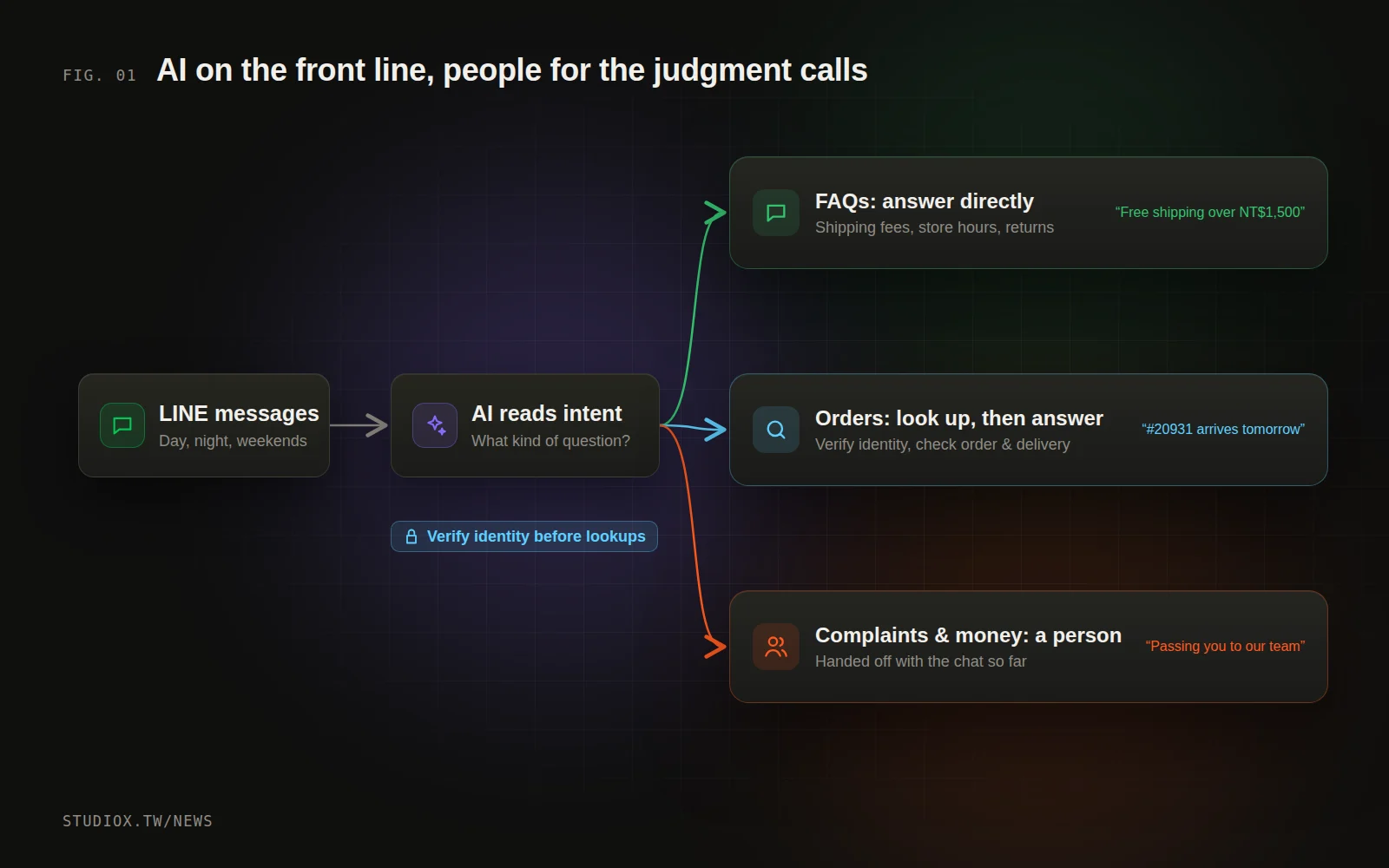
What we recommend isn't "hand everything to AI." It's a division of labor:
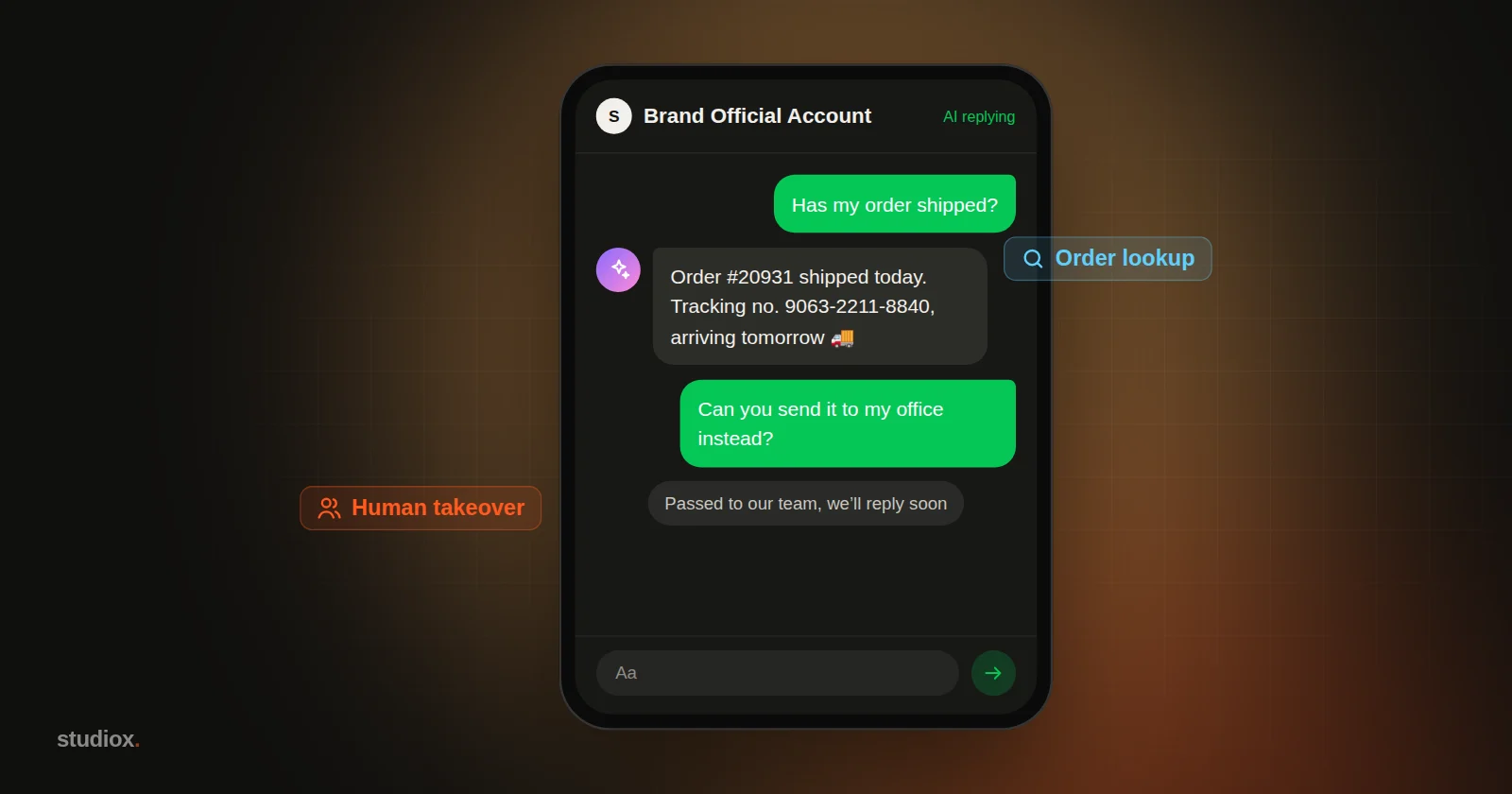
- AI replies first: it understands what the customer is asking, answers common questions, and looks up order and shipping status.
- AI decides when to hand off: complaints, upset customers, payment disputes, or questions it can't find an answer to go straight to a person.
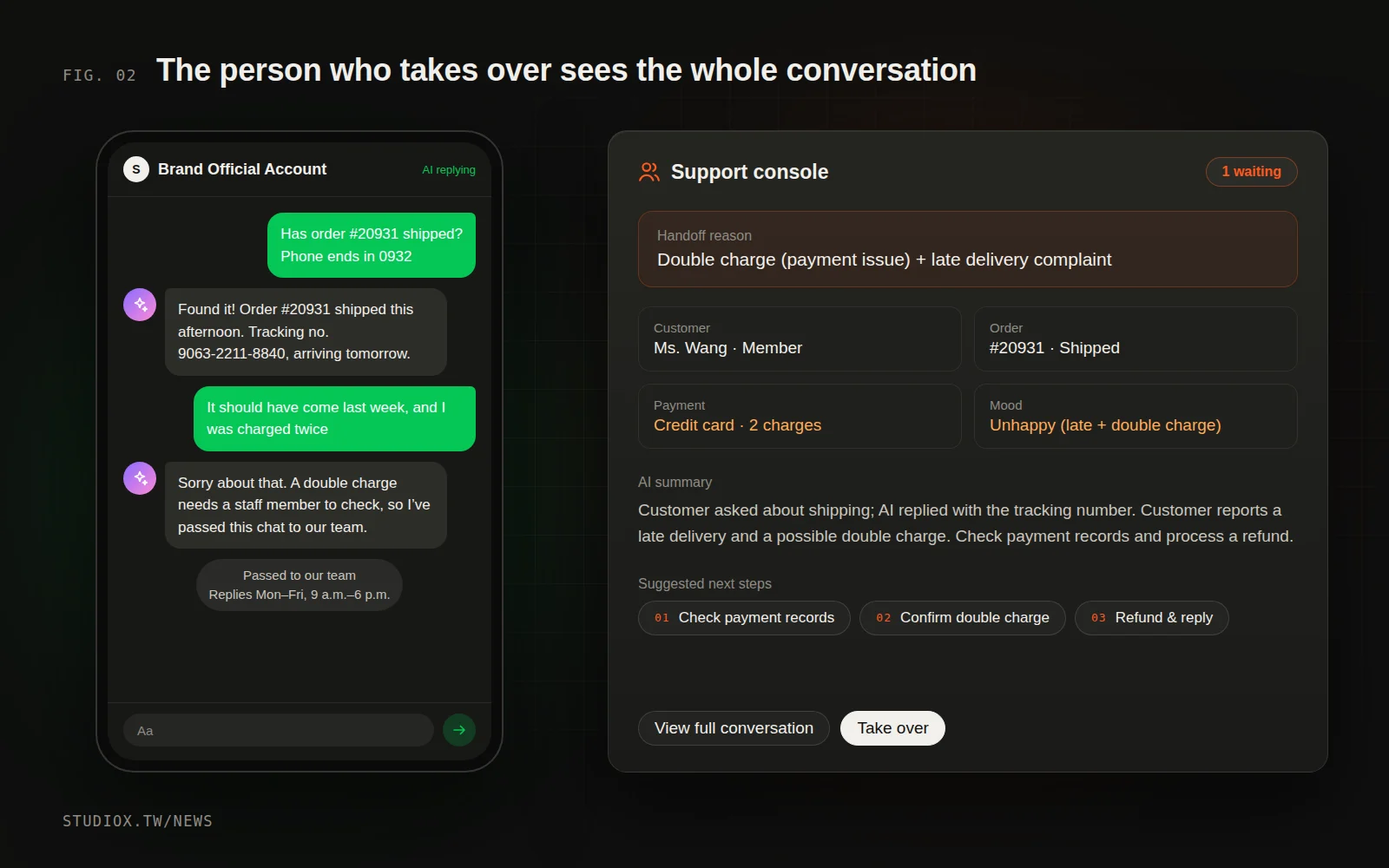
- The person who takes over sees the whole conversation: nobody has to ask the customer to start from the beginning.
AI is only really useful when it can check your systems
Plenty of FAQ-only chatbots disappoint, and the reason is simple: what customers ask about most is their own stuff. My order, my package, my refund.
To answer those questions, AI needs a safe way to look things up:
- Order system: payment status, shipping status, what's in the order.
- Shipping and logistics: where the package is now and when it should arrive.
- Inventory: whether a particular item, in a particular size, is in stock.
- Membership data: points, membership tier, coupons.
Before looking up anything personal, always verify the customer's identity first. For example, ask for the order number and the last few digits of their phone number, or only enable lookups after a member has linked their LINE account. The AI should only get the information it needs through lookup functions you've defined, not see your entire database. It's the same principle behind MCP's permission design.
When does a person have to take over?
Handoff rules are what make or break a hybrid setup. These are the situations we usually route to a person immediately:
- Complaints or clearly upset customers: strong language, repeated complaints, threats to report the business or leave a bad review.
- Money and customer rights: disputed refund amounts, requests for compensation, pricing errors.
- No answer in the data: rather than letting the AI guess, hand it to a person (see our hands-on guide to RAG knowledge bases).
- The customer asks for a person: the moment a customer says "I want to talk to a real person," don't let the AI stand in the way.
When you hand off, tell the customer clearly what happens next: "I've passed this to our team. Our customer service hours are Monday to Friday, 9 a.m. to 6 p.m., and we'll reply in the order messages come in."
Three metrics to watch after launch
- AI resolution rate: how many conversations AI handles from start to finish without a handoff. This number goes up as your knowledge base and lookup functions improve.
- Handoff reasons: record the reason for every handoff. If one type of question gets handed off a lot, you may be missing information, or it could become a new lookup function.
- Customer satisfaction: ask a quick "Was this reply helpful?" at the end of each conversation, and review a sample of conversations regularly.
Pre-launch checklist
Before you switch on AI customer service, make sure the following are in place:
Content
- Your top 10 questions each have a correct, up-to-date standard answer
- Rules for shipping, returns and exchanges, and payment methods are written down, not just stored in your agents' heads
- There's a set process for updating promotion details and end dates
Systems
- Order and shipping lookups are connected, with an identity check built in
- The support console shows the full conversation and lets agents take over the reply
- Every conversation is logged, searchable and exportable
Rules
- Handoff conditions are clearly defined
- You've settled on staffed hours and what to tell customers outside them
- You've decided how far the AI can go: only answer questions? Help change a delivery address? Accept return requests?
Team
- Agents know which questions the AI will handle and when it will hand off to them
- One person owns the process, reviewing logs and updating the knowledge base every week
The list looks long, but most of it is one-time cleanup. Once it's done, it doesn't just help the AI: training new support staff gets a lot easier too.
Suggested rollout steps
- Analyze the past month of messages: sort them into categories, find your top 10 questions and what share of volume each one accounts for.
- Gather what's needed to answer them: FAQs, return and exchange policies, shipping rules, and make sure they're all current.
- Connect lookup functions: start with the most-asked question, "Has my order shipped?"
- Set up handoff rules and the support console: agents need to see the full conversation and be able to take over the reply.
- Pilot during off-peak hours or with a subset of customers, watch it for two weeks, then roll it out fully.
Good AI customer service doesn't make it hard for customers to reach a person. It lets your people spend their time on the customers who actually need them. Hand the repeat questions to AI and the tricky ones to experienced colleagues: customers get answers faster, and your team is no longer chasing an endless stream of messages. To see how your LINE customer service could be upgraded, take a look at our integration and automation services, or just talk to us.