Jevons paradox: why cheaper AI means bigger AI bills
AI keeps getting cheaper, yet company AI bills keep growing. We trace the Jevons paradox from 1865 coal to today's AI, and show small businesses how to control AI costs and rethink staff roles.
Key takeaways
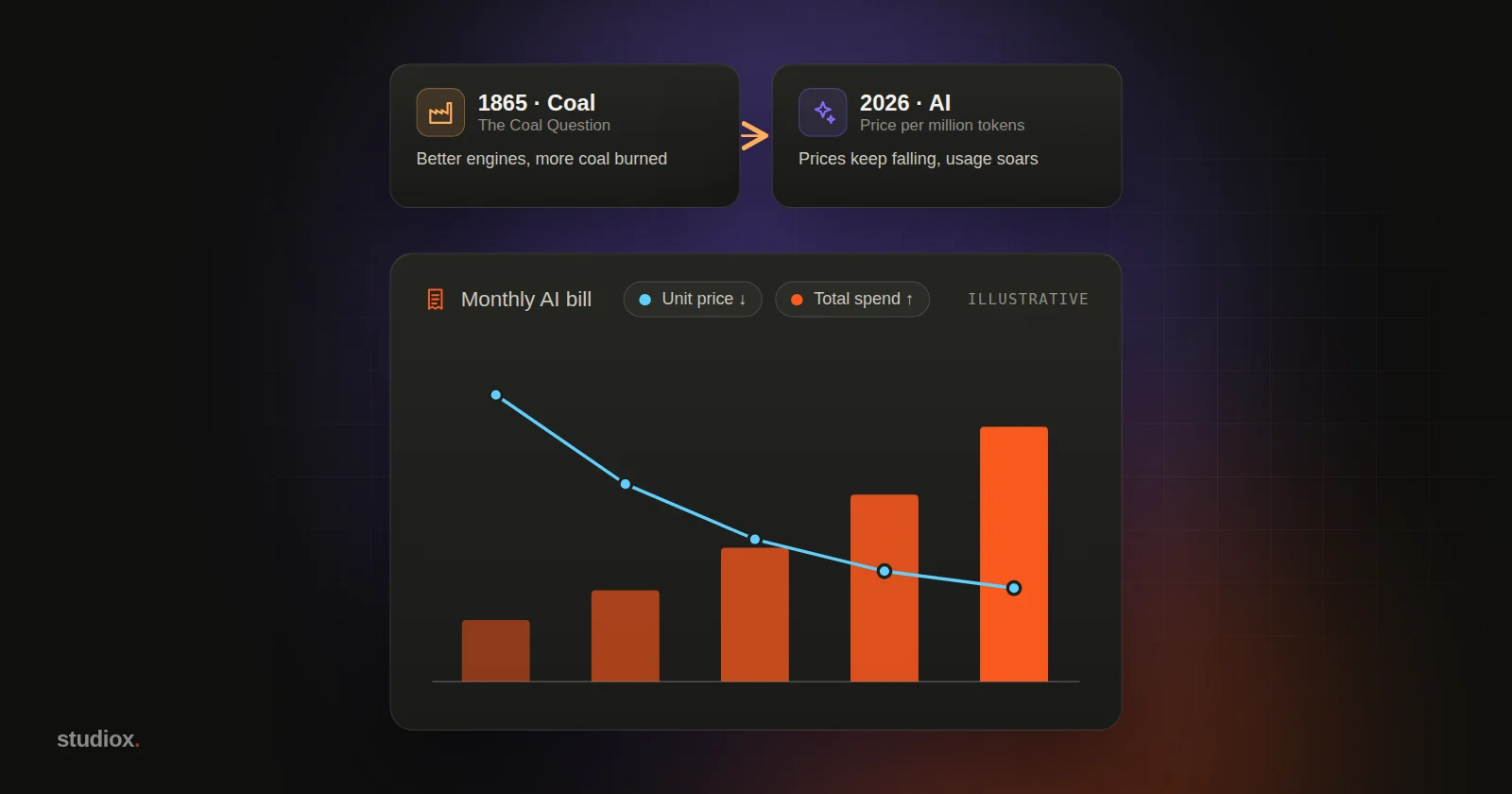
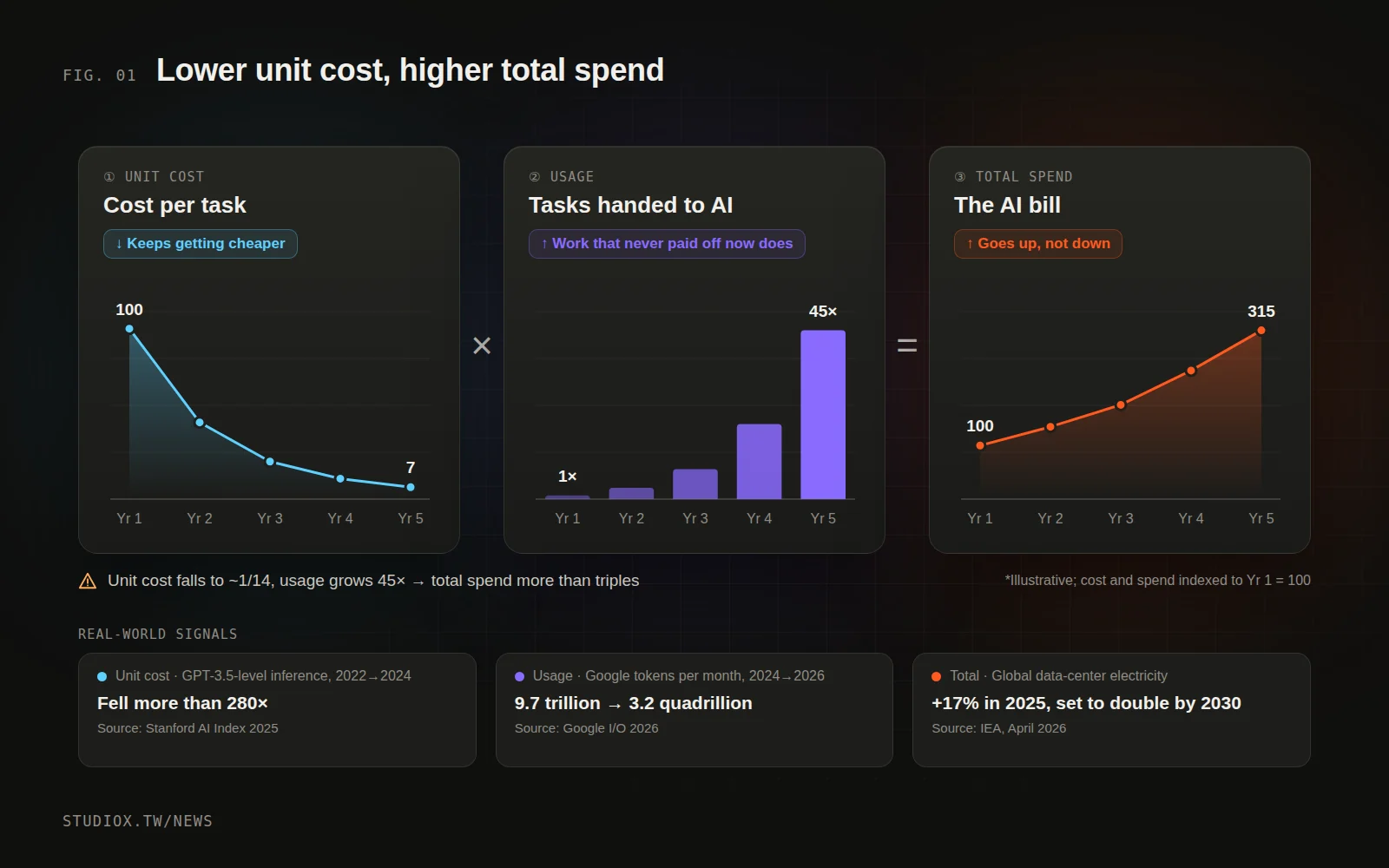
- The Jevons paradox: when efficiency lowers the cost per unit, usage can grow even faster, so total consumption rises. In 1865 it was coal; today it's AI.
- AI unit prices have fallen dramatically in recent years, while token volumes, AI spending and data-center electricity use are all growing fast.
- Company AI budgets grow mostly because work that never paid off now does. Track the cost per business outcome, not the total or the price per token.
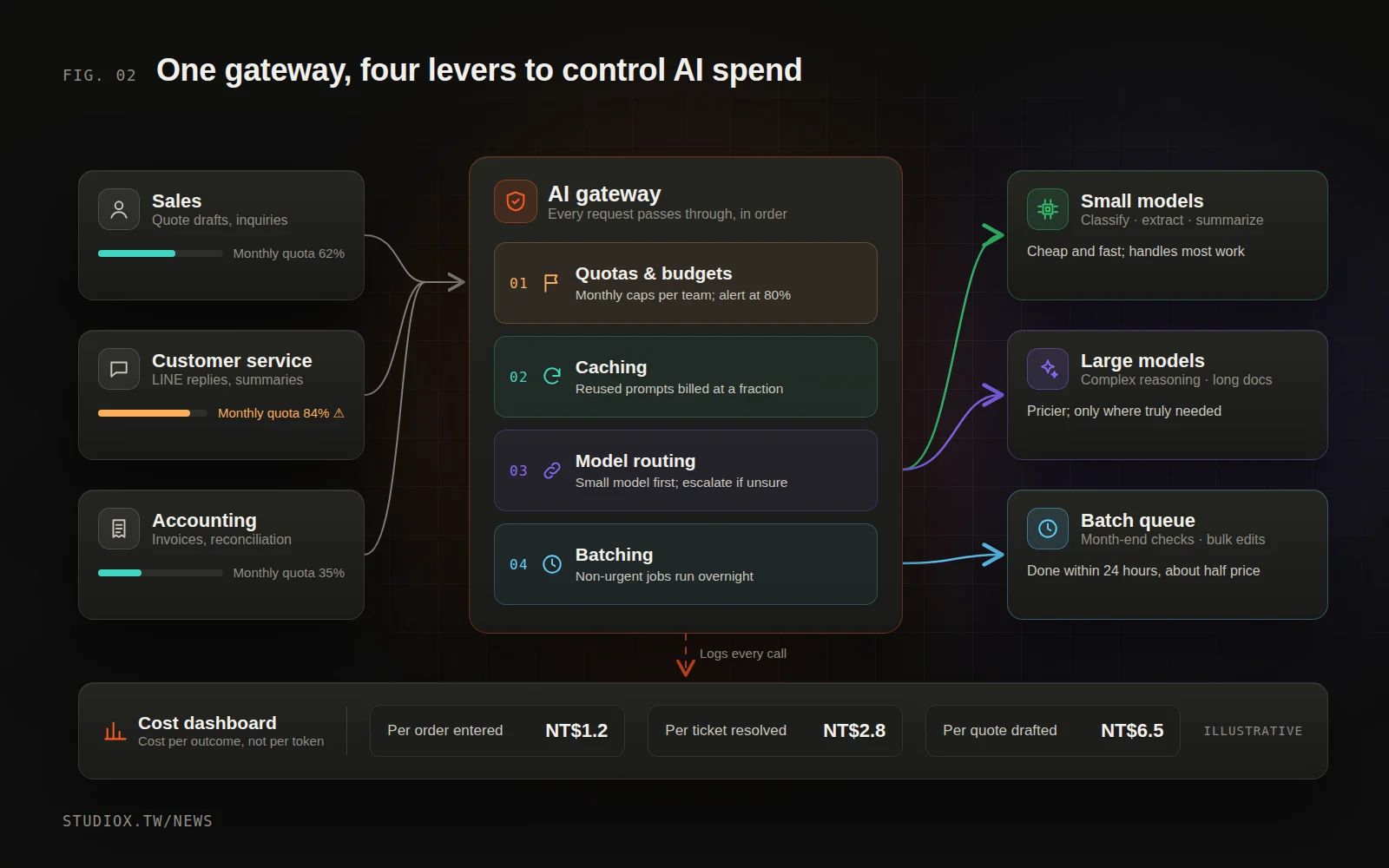
- Four levers keep costs in check: quotas and budgets, caching, model routing and batching. Staff roles shift toward review, exceptions and customer contact.
Table of contents
- The coal question of 1865: what is the Jevons paradox?
- Why it became the AI topic of 2025–2026
- Cheaper AI: fewer jobs or more?
- What it means for Taiwan's SMEs: why AI budgets keep growing
- Four levers for controlling AI costs
- What it means for your staff: roles change, they don't just disappear
- Where to start
"The news says AI prices just got cut again. So why does our AI bill keep going up?"
A lot of business owners and finance managers are asking this year. Last year, the company used AI to translate a few foreign-language emails, and the monthly cost was barely noticeable. This year, customer service uses it to answer messages on LINE (the messaging app most Taiwanese customers use), sales uses it to draft quotes, and accounting uses it to check statements. Each use costs less than it did last year, yet the total is several times higher.
Nobody is being careless. This is an economic pattern first described 160 years ago: the Jevons paradox. DeepSeek turned it into a tech buzzword in early 2025, and by 2026 it comes up in almost every conversation about AI costs, electricity and jobs. This article explains what it is, why it applies to AI, and what small and midsize businesses should do about it.
The coal question of 1865: what is the Jevons paradox?
In 1865, British economist William Stanley Jevons published The Coal Question. Many people assumed that James Watt's improved steam engine, which burned far less coal than older designs, would reduce Britain's coal consumption. Jevons pointed out the opposite: because the engines were cheaper to run, they were worth using in more places, in more factories, mines and railways, and the nation's total coal use soared.
In his words: "It is wholly a confusion of ideas to suppose that the economical use of fuel is equivalent to a diminished consumption. The very contrary is the truth."
The mechanism comes down to three steps:
- Efficiency improves: the same job takes fewer resources.
- Unit costs fall: uses that weren't worth it before now pay off.
- Uses and volume multiply: the new demand outweighs the savings, and total consumption rises.
This isn't an iron law. When demand is already saturated (switching to LED bulbs doesn't make you install ten more lamps), efficiency really does save resources. The Jevons paradox holds when there's a large pool of demand that went unmet because it was too expensive. AI is exactly that kind of case.
Why it became the AI topic of 2025–2026
DeepSeek and Nadella's post
In January 2025, Chinese startup DeepSeek released R1, a reasoning model known for its low cost, and markets began to worry that AI might not need so many chips after all. On January 27, Nvidia's stock fell about 17% in a single day, wiping out nearly $600 billion in market value, the biggest one-day loss ever for a U.S. company.
In the middle of that turmoil, Microsoft CEO Satya Nadella posted on X: "Jevons paradox strikes again! As AI gets more efficient and accessible, we will see its use skyrocket, turning it into a commodity we just can't get enough of." Almost overnight, a 19th-century economics term became one of tech's favorite phrases.
Unit prices keep falling, totals keep rising
More than a year and a half later, the numbers largely back Nadella up:
| What got cheaper | What grew | |
|---|---|---|
| Tokens | Inference for a model performing at GPT-3.5's level fell from $20 per million tokens in November 2022 to $0.07 in October 2024, a drop of more than 280× | The tokens Google processes each month grew from 9.7 trillion in May 2024 to 3.2 quadrillion in May 2026 |
| Electricity | Energy use per AI task has recently fallen by at least 10× a year | Global data-center electricity use grew 17% in 2025 and is projected to rise from 485 TWh to 950 TWh by 2030 (IEA) |
| 2026 | In July, OpenAI cut the price of GPT-5.6 Luna by 80%; in September, GPT-6 Sol and Luna halved prices again | Gartner forecasts worldwide AI spending of about $2.7 trillion in 2026, up 49.5% from the year before |
The International Energy Agency's April 2026 report reads almost like a textbook statement of the paradox: AI's energy efficiency per task is improving at a pace unprecedented in energy history, but more people are using AI and more energy-hungry uses such as AI agents are catching on, so total electricity demand keeps climbing.
Cheaper AI: fewer jobs or more?
The Jevons paradox has entered the jobs debate too. In April 2026, Apollo chief economist Torsten Slok described a "Jevons employment effect": as AI makes legal, accounting and consulting work cheaper, more people will buy those services, and employment in those fields could grow rather than shrink (as reported by Fortune).
Radiology is the go-to example. In 2016, AI pioneer Geoffrey Hinton said we should stop training radiologists now. Nearly a decade later, an analysis in Works in Progress found that despite hundreds of FDA-approved AI imaging tools, radiologists remain in short supply across the U.S., and residency programs offered a record number of positions in 2025.
The other side of the data matters just as much. An August 2026 update from the Stanford Digital Economy Lab found no sign of widespread job displacement across the economy. But in the occupations most exposed to AI, employment of workers aged 22 to 25 is about 19% below where it would be had it kept pace with their peers in less-exposed jobs. The gap comes mainly from companies hiring fewer young people, not from layoffs, and experienced workers show no similar gap.
The most defensible reading: the total amount of work may grow, but its makeup will change, and the first work affected is the routine work that new hires used to learn on.
What it means for Taiwan's SMEs: why AI budgets keep growing
Work that never paid off suddenly does
This is what the Jevons paradox looks like inside a company. Things you used to skip because staff were stretched or the cost was too high become worth doing once AI prices drop:
| Before | After AI got cheap |
|---|---|
| Only big customers got a same-day reply to inquiries | Every LINE inquiry gets an instant draft reply |
| Reconciliation spot-checked only large invoices | Every purchase order and invoice is matched automatically |
| Nobody had time to read support logs | Every conversation is summarized and tagged to surface recurring complaints |
| Product descriptions only in Chinese | Every product page has English and Japanese versions too |
Each item is cheap on its own, but together they can multiply the company's AI usage within a year.
Heavier use
Usage also grows because AI is being used in more demanding ways. Moving from simple Q&A to AI agents that look things up and call tools on their own, a single task can mean dozens of model calls. In a post about its research feature, Anthropic reported that agents typically use about 4× as many tokens as a chat, and multi-agent systems about 15×. Cheaper tokens don't automatically mean cheaper tasks.
Spending more isn't necessarily bad
If the extra money buys faster replies, fewer errors and more orders, a bigger budget makes sense. The real problem is when nobody knows where the money goes or what it buys.
Four levers for controlling AI costs
1. Quotas and department budgets
Give each department and each application a monthly quota, notify the owner at 80%, and review once a month. The point isn't to restrict use; it's to make sure every dollar has someone accountable for it.
2. Caching: don't pay full price for repeated content
Company policies, product catalogs and standing instructions get sent with every call. The major AI providers offer prompt caching; with Anthropic, for example, reading from the cache costs about a tenth of the normal input price.
3. Model routing: send simple jobs to small models
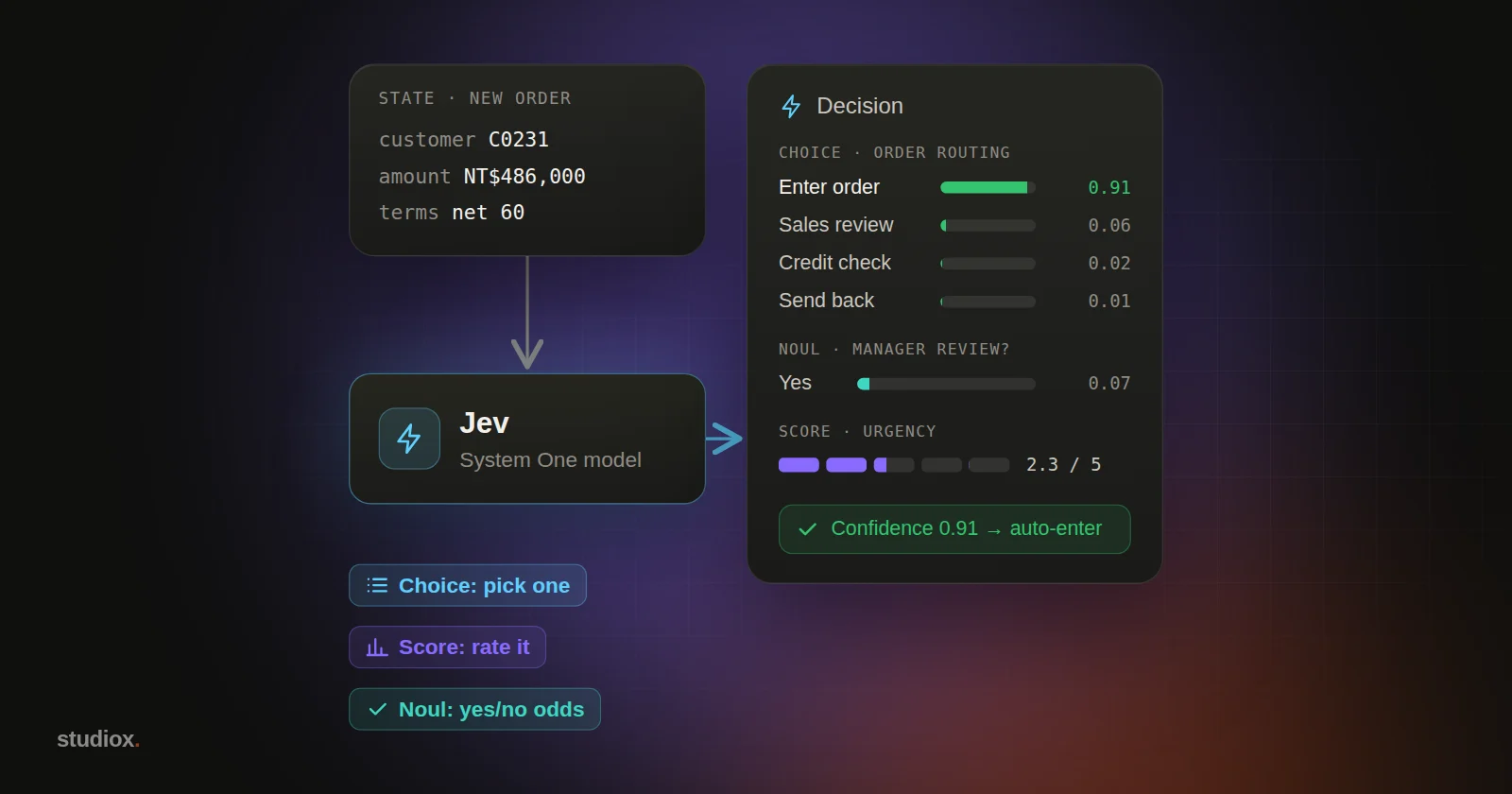
Send well-defined work like classification, field extraction and summarization to a cheap, fast small model (possibly an on-premise small model running in-house), and save large models for complex reasoning and long documents. Add a rule that anything the small model isn't sure about gets escalated, and you keep both quality and cost in check.
4. Batching: run non-urgent work overnight
Month-end reconciliation, bulk rewrites of product descriptions and cleanup of historical records don't need instant answers. OpenAI and Anthropic both offer batch APIs that finish within 24 hours at roughly half the price of real-time calls.
Measure cost per outcome, not per token
The most important shift in thinking: don't just watch the price per token. Track what it costs to get one thing done, such as the cost per order entered or per customer issue resolved, and compare it with the previous labor cost and error rate. That's how you tell whether a bigger budget means more valuable work or simply waste.
What it means for your staff: roles change, they don't just disappear
In the projects we've seen, AI takes over steps, not jobs: data entry, formatting and first drafts go to AI, while people review, handle exceptions, talk to customers and make the final call.
A few practical suggestions:
- Take stock of tasks, not people: list the tasks in each role and decide which ones suit AI and which need a person.
- Redesign how new hires learn: juniors used to learn the business through data entry and tidying up records; now they can review AI output alongside senior colleagues.
- Give the saved time somewhere to go: replying to customers faster, taking on more orders and reaching markets you never had time for is where the real return on AI comes from.
Where to start
- Get a clear view of spending: list every AI service and subscription the company uses, what each costs per month, who uses it and for what.
- Calculate the cost per outcome for one process: pick a process that already uses AI, work out the cost of each completed task, and compare it with doing it by hand. If you haven't started with AI yet, Where to start with AI can help you pick the process most worth automating.
- Put quotas and routing in place: start with your highest-volume application, set department quotas, and move simple tasks to small models.
AI will keep getting cheaper, and your company will probably keep spending more on it. That's fine, as long as every dollar buys results you can see. If you want help deciding which models your processes need and how to set up routing and cost tracking, take a look at our AI integration services, or tell us what you're working on.